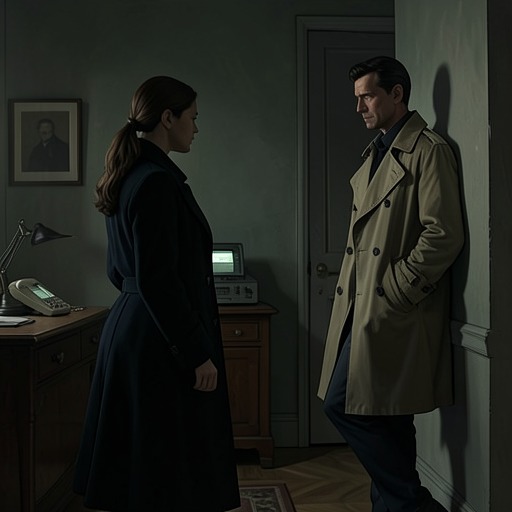
Dorothea Langrishe
The Black-Eyed BlondeDorothea Langrishe is Clare Cavendish’s mother, an Irish-born widow and the founder of Langrishe Fragrances, Inc. Her wealth and commanding presence make her a prominent figure in Clare’s family world, while the history behind her success reveals a woman who has rebuilt her identity after bereavement and separation. She is also kept outside a damaging family secret: the truth about her son’s drug problem is concealed from her, partly because Clare fears the distress its revelation would cause.
Identity and Background
Dorothea was widowed in Ireland and came to the United States with her daughter, Clare. She later recalled that her husband had been killed in the Irish conflict while serving with the men of Michael Collins. When Marlowe referred to the Irish wars, she connected the subject to that personal loss, making clear that the history was not merely political to her. She described her husband as having been murdered, and her brief recollection placed grief from her earlier life behind the forceful, successful woman Marlowe meets.
Her name also reflects a deliberate shaping of identity. Langrishe was her maiden name, and after arriving in the United States she married again, to Mr. Edwards. He later left her, but she continued to prefer Langrishe, considering it a more suitable name. She explained that she had been christened Dorothy and called Dottie, names she regarded as poor choices for a perfume label. The distinction between Dorothy Edwards and Dorothea Langrishe is therefore more than a matter of form: the name she uses publicly joins her work and public reputation to her earlier family identity, rather than to the marriage that ended.
Business and Expertise
After arriving in Los Angeles, Dorothea founded Langrishe Fragrances, Inc. The company became highly successful, and Clare identifies herself as rich because of the business her mother built. Dorothea says she works with her mother, though she notes that her mother prefers to describe the arrangement as working together rather than simply working for her. The phrasing suggests both the company’s family character and Dorothea’s authority within it: she created the business, while Clare participates in its operation.
Dorothea’s knowledge of perfume is practical and specific. She explains that many products in the industry rely on attar of roses, whereas her own secret is rose absolute, extracted through solvents rather than distillation. She identifies Bulgaria as its source and describes how the roses are harvested before sunrise, when their fragrance is strongest. Producing an ounce requires at least 250 pounds of petals. Her account links the technical process to the scale and expense of the product, and to the commercial achievement she takes pride in: she made her fortune from the damask rose. The speech shows that her success rests not only on wealth but on expertise she can explain in detail.
Character and First Meeting with Marlowe
Marlowe’s first meeting with Dorothea overturns his expectation that Clare’s mother would resemble her daughter in temperament and appearance. Dorothea is small, dressed in a pink satin suit, and unmistakably self-possessed. Before speaking with Marlowe, she instructs a waiter at length on how to prepare tea, specifying the boiling water, the scalded pot, the amount of tea, and the steeping time. The exchange establishes her exacting manner through an ordinary task: she expects people to follow her directions, and she is willing to correct them openly.
She then has Marlowe sit beside her so she can examine him and asks whether he is working for Clare. Her attention is direct, and she soon asks what her daughter has hired him to do. Marlowe, meanwhile, wonders how Dorothea found out about him. Clare later explains that Richard told her mother, since he tells her everything. Dorothea’s access to information thus comes through the family’s communication patterns, rather than through any account of her independently investigating Marlowe. Although she asks about Clare’s commission, the available conversation does not establish what she learns about the case.
Family Relationships and Concealed Trouble
Clare’s description of her marriage to Richard reveals an unusual closeness between Richard and Dorothea: Clare sometimes feels that Richard is married to her mother instead of to her. She says he tells Dorothea everything. This makes Dorothea an important presence in the marriage even when she is not part of the conversation, because information passes between Richard and her and leaves Clare feeling displaced.
That closeness has a limit. When Marlowe raises whether Dorothea should be told about the drug problem affecting her son, Clare reacts with alarm and insists that her mother must not know. She believes the revelation would break Dorothea’s heart. Clare also explains that Richard threatens to tell her mother when he is angry, using the possibility of disclosure as one of the ways he maintains power over Clare. The threat depends on Dorothea’s importance to her daughter and on Clare’s wish to spare her; it does not show that Dorothea herself knows of the problem.
Narrative Role and Significance
Dorothea’s business success and family history give weight to Marlowe’s later appeal to Clare. When he warns Clare about the consequences of a scandal, he urges her to consider what it would do to her mother, who has already endured violence and grief. His plea invokes Dorothea’s past without claiming that she knows the present danger. In this way, her remembered losses become part of the pressure on Clare to consider what disclosure might cost her family.
The contrast between Dorothea’s public competence and private vulnerability is central to her limited but consequential role. She can build a prosperous company, explain a costly perfume ingredient, and command attention in a social encounter; yet Clare’s fear of hurting her keeps her ignorant of a grave family problem. Dorothea is not shown resolving the investigation or learning its full circumstances. Instead, she stands at the intersection of family loyalty, business identity, and concealed truth: a powerful mother whose protection is sought even as others decide what she must not be told.